

highchair, weeping over a dropped piece of fruit. The parent, exhausted from a long day of work and desperate for just ten minutes of peace to cook dinner, hands over a smartphone. Instantly, the crying stops. The toddler’s thumb moves with practiced precision—swipe, tap, swipe. Tears dry up, replaced by the soft, blue-lit glow of a hypnotic animated video.
Peace is restored. But at what cost?
We are currently living through a massive, unprecedented psychological experiment. For the first time in human history, children are mastering complex digital interfaces before they have even developed the neurological wiring to manage their own emotions. Put simply: kids today know how to swipe before they know how to self-regulate.
This isn’t just a casual observation about “kids these days” and their gadgets. It is a profound developmental crisis. When an infant’s primary tool for soothing distress is an external digital device rather than an internal emotional coping mechanism, we fundamentally alter the architecture of the developing brain.
To understand how we got here—and more importantly, how we can steer our children back toward healthy development—we need to look closely at the collision between modern tech design, modern school ecosystems, and early childhood neurology.
Alternative Headings for the Modern Digital Age
Depending on the specific audience you are targeting (parents, educators, or school administrators), here are a few alternative headings that seamlessly integrate modern child safety and educational concepts:
- The Dopamine Pacifier: Balancing Early Screen Mastery with a Smart School Management System
- Swiping Through Tantrums: Why Today’s Kids Need Screen Time Control More Than Ever
- The Connected Student: Navigating Internet Safety For Kids in a Hyper-Digital World
- Beyond the Touchscreen: Combining Parental Control With Location Tracking and Emotional Resilience
- The Wired Toddler: How to Leverage a School Mobile App Without Over-Stimulating Developing Brains
1. The Chemistry of the Swipe: Why Screens Win the Attention War
To understand why a toddler can navigate an iPad with the dexterity of a seasoned tech executive, we have to understand the concept of affordance and neurological reward.
Touchscreens are an engineering marvel because they require zero instruction. Unlike a computer mouse or a keyboard, which requires abstract symbolic thought and fine motor coordination, a touchscreen responds to instinct. A baby reaches out, touches a bright object, and something happens. Cause and effect are instantaneous.
But tech companies didn’t stop at simple functionality. They engineered these platforms using the same psychological principles that make slot machines addictive: variable reward schedules.
The Dopamine Loop
When a child swipes a screen and a new, brightly colored video pops up with upbeat music, their brain releases a micro-dose of dopamine—the neurotransmitter associated with pleasure and reward. Because the content is unpredictable (you never know what the next short video or algorithmic recommendation will be), the brain stays locked in a state of constant anticipation.
Compare this to the physical world. If a child wants to build a tower out of blocks, they have to locate the blocks, use shaky motor skills to stack them, deal with gravity when the tower falls, and tolerate the frustration of failure. The physical world operates on a delay. It requires effort, patience, and coping strategies for when things go wrong.
The digital world offers maximum reward for absolute minimum effort. When given the choice between the hard work of physical play and the instant gratification of a swipe, a child’s brain will choose the swipe every single time.
2. What exactly is Self-Regulation? (And Why It Matters)
To understand what screens are taking away, we must first define what self-regulation actually is.
Self-regulation is not just “being good” or sitting quietly. It is a complex, multi-layered psychological framework that allows a human being to manage their internal states. It includes:
- Emotional Regulation: The ability to experience a strong emotion (anger, sadness, frustration) without throwing a massive tantrum or becoming aggressive.
- Behavioral Regulation: The capacity to inhibit an impulse (e.g., not grabbing a toy out of another child’s hand, or waiting your turn in line).
- Cognitive Regulation: The ability to focus attention, switch tasks flexibly, and ignore distractions.
Self-regulation is the foundation upon which all future academic, social, and personal success is built. A child who cannot self-regulate will struggle to pay attention in school, find it difficult to make friends, and experience higher rates of anxiety and depression later in life.
The Developmental Timeline
The prefrontal cortex—the area of the brain responsible for executive functions like self-regulation—is the most immature part of the brain at birth. It develops slowly throughout childhood and isn’t fully formed until a person reaches their mid-twenties.
During the first five years of life, the brain is hyper-plastic. It builds neural pathways based on experience. If a child experiences distress and is helped to calm down by a parent, they are building the neural pathways for self-regulation. If a child experiences distress and is handed a screen, they are bypassing that neural construction zone entirely.
3. The Digital Pacifier: How We Accidentally Outsourced Emotional Coping
Parents do not hand over screens out of malice. They do it out of survival. Modern parenting is incredibly demanding, often lacking the village or community support that previous generations relied upon. When you are trying to navigate a grocery store run or handle a remote work meeting, a quiet child is a necessity.
However, using a screen as an emotional management tool—a “digital pacifier”—creates a dangerous cycle.
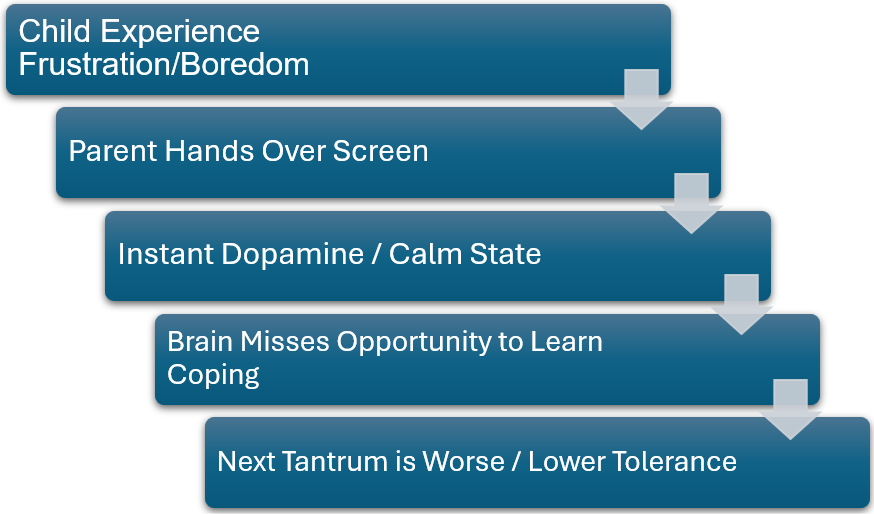
When a screen is used to interrupt a tantrum, the child learns a damaging lesson: I do not need to learn how to tolerate uncomfortable feelings, because an external device will cure them instantly.
When the screen is eventually taken away, the emotional crash is catastrophic. Parents often mistake this intense anger as a sign that their child just “really loves their iPad,” but it’s actually a classic withdrawal response. The brain has been stripped of its dopamine source, and because it hasn’t practiced self-soothing, it plunges into total chaos.
4. The Erasure of Boredom: Why a Restless Mind is Essential
One of the greatest casualties of the swipe-first era is boredom.
In the pre-smartphone era, boredom was a frequent companion of childhood. It was the empty space during a long car ride, the rainy afternoon with nothing to do, or the wait at a doctor’s office. While boredom feels uncomfortable, it serves an vital evolutionary purpose: it is the primary catalyst for imagination, creativity, and introspection.
When a child is bored, their brain enters what neuroscientists call the Default Mode Network (DMN). This network is active when we are daydreaming, reflecting, processing memories, and thinking about the future. It is where original ideas are born.
Today, boredom has been effectively eradicated. The moment a child experiences a micro-second of stillness, a screen is inserted to fill the void.
The Loss of Cognitive Endurance
By protecting children from the discomfort of boredom, we are inadvertently weakening their cognitive endurance. Reading a book requires sustained, focused attention without immediate reward. Listening to a teacher explain a math problem requires sitting with confusion until clarity emerges.
If a child’s brain is conditioned to receive a new sensory stimulation every seven seconds (the average length of a modern short-form video clip), sitting through a 45-minute school lesson becomes an excruciating form of sensory deprivation. We are creating a generation of children who are highly reactive but deeply unreflective.
5. The School Factor: Modern Education Meets Digital Overload
As children transition from toddlers to students, the digital challenge doesn’t disappear; it evolves. Modern educational institutions are actively grappling with this attention deficit. To keep up with a hyper-connected generation, schools are adopting advanced infrastructure, shifting from paper to pixel.
Systemic Changes in Modern Schools
Progressive schools are moving toward a unified School Erp Software to manage everything from admissions to daily operations. These centralized systems change how students and parents interact with the educational ecosystem:
- Integrated Data: A comprehensive Student Management System tracks academic performance alongside behavioral trends, helping educators identify when digital fatigue is impacting a child’s grades.
- Automated Logistics: From tracking tuition through a School Fee Management System to recording daily arrival via a Biometric Attendance System For Schools, the logistical side of education is faster than ever.
- Instant Updates: Parents are kept completely in the loop through a dedicated School Mobile App, which delivers real-time notifications about homework, announcements, and events directly to their phones.
While these tools streamline administrative burdens beautifully, they also mean that a child’s educational world is fundamentally anchored to the digital grid. If a student is opening a device to check their grades or view an assignment sheet, the temptation to stray into mindless scrolling is only a single click away.
6. The Long-Term Consequences: A Look Into the Future
If we do not address this gap between digital proficiency and emotional maturity, what happens when this generation grows up? We are already beginning to see the early warning signs in classrooms and pediatric clinics worldwide.
| Area of Impact | The Screen-Dependent Trajectory | The Well-Regulated Trajectory |
| Attention Span | Fragmented, requires high-stimulation inputs to remain engaged. | Sustained, capable of focusing on low-stimulation tasks (reading, listening). |
| Frustration Tolerance | Low; gives up quickly when answers or results aren’t instantaneous. | High; views mistakes as part of learning and persists through difficulty. |
| Social Interactions | Prone to conflict; struggles with sharing, waiting, and reading peers’ emotions. | Collaborative; understands turn-taking and displays situational empathy. |
| Sleep Patterns | Disrupted by blue light exposure and late-night sensory hyper-arousal. | Consistent; brain transitions naturally into rest states without artificial aids. |
The Academic Deficit
Teachers globally are reporting a stark shift in classroom dynamics. Children are entering kindergarten knowing how to open apps and skip ads, but they cannot sit still for a story, hold a pencil correctly, or handle the minor disappointment of losing a simple game.
When modern schools deploy an advanced Examination Management System to assess student progress, the data often reveals a glaring trend: children are highly capable of passing standardized, predictable metrics, but they struggle deeply with open-ended, complex problem solving that requires sustained focus. When the answer isn’t immediately obvious, their frustration tolerance bottoms out.
7. The Blueprint for Balance: How to Reclaim Childhood
Acknowledging this problem isn’t about shaming parents or dismissing the benefits of educational technology. Technology is a tool, and like any tool, its impact depends entirely on how it is used. The goal is to shift our focus from digital consumption to emotional construction, creating a safe digital sandbox for our kids to grow in.
Step 1: Deploy Robust Digital Guardrails
Just as we wouldn’t let a child wander a crowded city center alone, we cannot let them explore the vastness of the internet without protection. Parents must actively enforce boundaries using modern software tools.
- Enforce Strict Guardrails: Utilizing targeted Screen Time Control ensures that devices lock automatically after a set period, preventing a child from sliding into a multi-hour dopamine binge.
- Block Digital Hazards: Parents should proactively install a reliable App Blocker For Kids to keep addictive social media platforms and age-inappropriate games completely out of reach.
- Prioritize Safe Exploration: True Internet Safety For Kids involves filtering out the noise of the open web. By implementing a proactive Parental Control With Location Tracking setup, parents can ensure their children are safe both online and in the physical world.
Step 2: Harmonize Home and School Technology
Modern school communication shouldn’t contribute to digital overwhelm. Parents and institutions can work together to ensure technology remains a utility, not a distraction.
- Streamline School Communications: Schools can utilize a dedicated School Crm System to manage parent outreach thoughtfully, avoiding a non-stop barrage of chaotic notifications.
- Protect the Commute: Physical safety can be managed digitally without requiring the child to hold a phone. By relying on a comprehensive Transport Management System For Schools—which often includes a secure Cloud-based School Erp Gps Tracker For Kids—parents can monitor the school bus route in real-time, completely eliminating the need to give a young child a personal smartphone just to stay in touch during the commute.
8. Role Modeling: The Mirror in the Room
We cannot talk about children’s screen usage without looking honestly at our own behavior. Children are master imitators. If they see their parents constantly glancing at their phones during conversations, checking notifications at red lights, or using screens to escape their own stress, they will internalize that behavior as normal and correct.
“Our kids are not listening to what we say; they are watching what we do.”
Practical Steps for Parents:
- The “Hello/Goodbye” Ritual: When you greet your child after a long day or say goodbye in the morning, put your phone completely out of sight. Give them five minutes of pure, uninterrupted eye contact and presence.
- Narrate Your Screen Use: If you must use your phone in front of your child for a practical task, explain what you are doing out loud. Say, “I am checking the school bus location on our app,” or “I need to pay this utility bill real quick, then I am putting my phone away.” This helps the child understand that the device is a tool with a specific purpose, not an infinite portal of distraction.
- Practice Digital Fasting: Dedicate an afternoon or a weekend day to a family “digital detox.” Turn off phones, put them in a basket, and spend the day engaged in shared physical activities. Show your children that life is richer, more vibrant, and far more interesting when it is lived in three dimensions.
Conclusion: Trading the Swipe for the Self
Technology is here to stay, and our children will undoubtedly need digital literacy to navigate the future economy. But digital literacy is easy to acquire; human emotional maturity is not. A child can learn how to navigate an app in a few minutes, but learning how to manage anxiety, cultivate deep focus, and experience empathy takes a lifetime of practice.
We must stop treating touchscreens as harmless babysitters or inevitable evolutionary steps. They are powerful psychological tools that are reshaping the childhood landscape.
By stepping in, setting firm boundaries, restoring the value of boredom, and prioritizing human connection over digital consumption, we can give our children the greatest gift possible: a brain that is wired not just to swipe, but to think, feel, and master its own destiny. Let’s make sure our kids learn how to calm their own hearts before they learn how to unlock a screen.