

The modern smartphone screen has become a masterclass in behavioral engineering. With a single flick of a thumb, an individual can cross oceans of information, traverse centuries of history, and view dozens of human faces. This action is effortless, frictionless, and above all, fast.
Yet, as the physical speed of our information consumption approaches the instantaneous, an unsettling paradox emerges within our educational institutions: “scrolling is fast, but learning remains painstakingly slow”.
The human brain requires time, focused attention, and mental energy to convert passing stimuli into working memory, and eventually, into permanent knowledge. When the environment surrounding our students and educators favors the quick hit over deep processing, our cognitive architecture suffers.
To bridge this widening chasm between rapid digital consumption and slow intellectual growth, schools cannot simply retreat into a pre-digital past. Instead, educational institutions must deploy a comprehensive ecosystem—specifically a Smart School Erp Solution—designed to transform chaos into structured, intentional engagement.
By building a unified Digital Platform For School Stakeholders schools can systematically combat the fragmented attention spans of the modern era, returning focus to where it truly belongs: deep, lasting learning.
1. The Psychology of the Infinite Scroll: Why Speed Destroys Retention
To understand why modern students struggle to retain information, we must examine the mechanics of the digital environment they inhabit daily. The “infinite scroll” is not merely a user interface design choice; it is a highly effective psychological mechanism optimized to exploit the human brain’s reward center.
The Dopamine Loop of Uncertainty
When a user scrolls through a social media application or a rapid-fire content feed, they enter what psychologists call a variable reward schedule. This is the exact mechanical principle that makes slot machines addictive. The brain does not know if the next piece of content will be highly engaging, humorous, or thoroughly boring.
This profound uncertainty triggers a surge of dopamine—the neurotransmitter responsible for anticipation and craving.
The brain is effectively rewarded not for understanding what it just saw, but for seeking what comes next. Consequently, the user enters a state of “zombie-scrolling,” where the executive function of the prefrontal cortex is completely bypassed. The mind is fully stimulated, yet fundamentally disengaged.
Cognitive Overload and the Suppression of the Default Mode Network
True learning requires that information move from sensory memory into working memory, and finally through a process called consolidation into long-term memory. However, the human working memory has strict limits. When a student reads 50 different short-form content pieces or distinct notifications within a 15-minute window, the brain experiences extreme cognitive overload.
Every single piece of content requires a total shift in context. This rapid context switching carries a heavy “switching cost.” The brain must expend massive amounts of metabolic energy just to reorient itself to each new stimulus, leaving zero cognitive resources available for deep processing or critical analysis.
Furthermore, this non-stop bombardment starves the brain’s “Default Mode Network (DMN)”. The DMN is the neural network that activates when a human being is daydreaming, reflecting, or resting quietly. It is within this quiet mental space that creative insights, self-reflection, and long-term memory consolidation happen. By replacing moments of healthy boredom with instantaneous digital input, we eliminate the very mental soil required for long-term learning to take root.
2. The Reading Brain Under Threat: Shifting from Depth to Rote
The capacity to read deeply and think critically is not an innate biological trait. Unlike speech, which humans evolve to pick up naturally through immersion, the “reading brain” must be painstakingly constructed over years of childhood development. This architectural process relies heavily on neuroplasticity—the brain’s ability to reorganize itself by forming new neural pathways in response to repeated experiences.
The Erosion of Deep Literacy
When a child’s primary mode of interacting with text is through screens filled with hyperlinks, pop-ups, and flashing advertisements, their neural pathways optimize for quick scanning, skim-reading, and superficial keyword spotting.
The consequences of this shift are increasingly evident in schools worldwide:
- The Death of Sustained Arguments: Students increasingly struggle to follow complex, multi-layered narratives or long-form logical arguments across chapters.
- Loss of Cognitive Patience: If a text does not offer immediate clarity or emotional stimulation within the first two paragraphs, the reader experiences an immediate urge to “scroll away” to something easier.
- Impaired Synthesis: The ability to read three different perspectives on a single historical event and synthesize them into a cohesive, nuanced conclusion is being replaced by a preference for absolute, single-sentence explanations.
The Rise of Rote Activity Over Focused Attention
In her extensive research on global attention spans, Dr. Gloria Mark at the University of California observed an alarming trend: the average attention span on a digital screen plummeted from 2.5 minutes in 2004 to roughly 47 seconds in recent years. This fragmentation splits our consciousness into two distinct modalities:
- Focused Attention: Active, deliberate, and high-energy cognitive engagement (e.g., solving an advanced calculus problem or evaluating a historical text).
- Rote Activity: Passive, low-demand, repetitive actions that require virtually no critical thought (e.g., clicking “Next,” swiping up, or checking notification badges).
When the surrounding culture prioritizes rote interactions, the mental muscle memory for focused attention atrophies. In the classroom, this manifests as a profound resistance to slow learning. Education becomes something to be skimmed, summarized by an algorithm, and forgotten immediately after an assessment.
3. Reclaiming the Classroom: The Need for Intentional Educational Infrastructure
If the outside world is optimized for rapid distraction, the modern school must serve as a sanctuary for deliberate focus. However, achieving this balance is not as simple as banning smartphones or returning entirely to paper and chalk. Technology is an inescapable facet of modern life; our objective must be to transform it from a source of chaotic distraction into an instrument of ordered focus.
To accomplish this transformation, school leaders must dismantle the fragmented, piecemeal software tools that currently plague classrooms. When teachers use one app for attendance, another for grading, a third for messaging, and students must check multiple portals for homework, the school environment mirrors the chaotic context-switching of social media.
Instead, institutions must consolidate their operations into an intentional, highly organized infrastructure powered by a Smart School Erp Solution.
An Enterprise Resource Planning (ERP) platform designed specifically for education acts as a digital nervous system for the school. It replaces the frantic, hyper-stimulating digital noise with a structured, predictable, and clean digital workspace. When software is streamlined, predictable, and functional, it removes the friction that triggers digital fatigue, giving teachers and students the mental breathing room required to slow down and focus on deep intellectual work.
4. Smart School Erp Solution: Structuring the Chaos of Modern Education
A Smart School Erp Solution directly combats the “scrolling mindset” by organizing information systematically rather than algorithmically. Social media feeds are explicitly engineered to keep users off-balance, serving a randomized sequence of information to drive continuous scrolling. An educational ERP does the exact opposite: it provides absolute structural clarity.
| Architectural Component | The Social Media Feed (Distraction Model) | The Smart School ERP (Focus Model) |
|---|---|---|
| Information Delivery | Algorithmic, unpredictable, continuous | Categorized, predictable, milestone-based |
| Cognitive Demand | Low-effort rote scrolling, passive consumption | Goal-oriented interaction, active engagement |
| User Objective | Infinite retention on the screen | Efficient utility to return to offline tasks |
| Data Visualization | High-stimulation metrics (likes, views) | Progress tracking (growth charts, skill gaps) |
Streamlining Administration to Protect Classroom Time
Every minute a teacher spends navigating clunky software, resetting lost passwords across separate systems, or manually cross-referencing paper grade sheets is a minute stolen from meaningful instruction. A modern educational ERP automates these administrative burdens into a single, cohesive interface.
- Automated Record Keeping: Attendance, fee collection, and grading are handled through automated workflows, allowing educators to focus entirely on curriculum design and individual student interventions.
- Unified Academic Portals: Lesson plans, assignments, and curriculum maps are hosted in a structured directory. Students don’t have to search through chaotic email threads to find out what they need to study; their entire academic path is clearly mapped out before them.
- Reduction of Extraneous Cognitive Load: By presenting text, deadlines, and learning objectives in a clean, minimalist design devoid of distracting advertisements or notifications, the platform protects the user’s limited working memory.
5. Digital Platform For School Stakeholders: Unifying Parents, Teachers, and Students
Learning does not happen in a vacuum. For slow, deep learning to occur, the efforts within the school walls must be reinforced and supported at home. This requires a dedicated, unified Digital Platform For School Stakeholders that brings parents, educators, administrators, and students into a shared, transparent space.
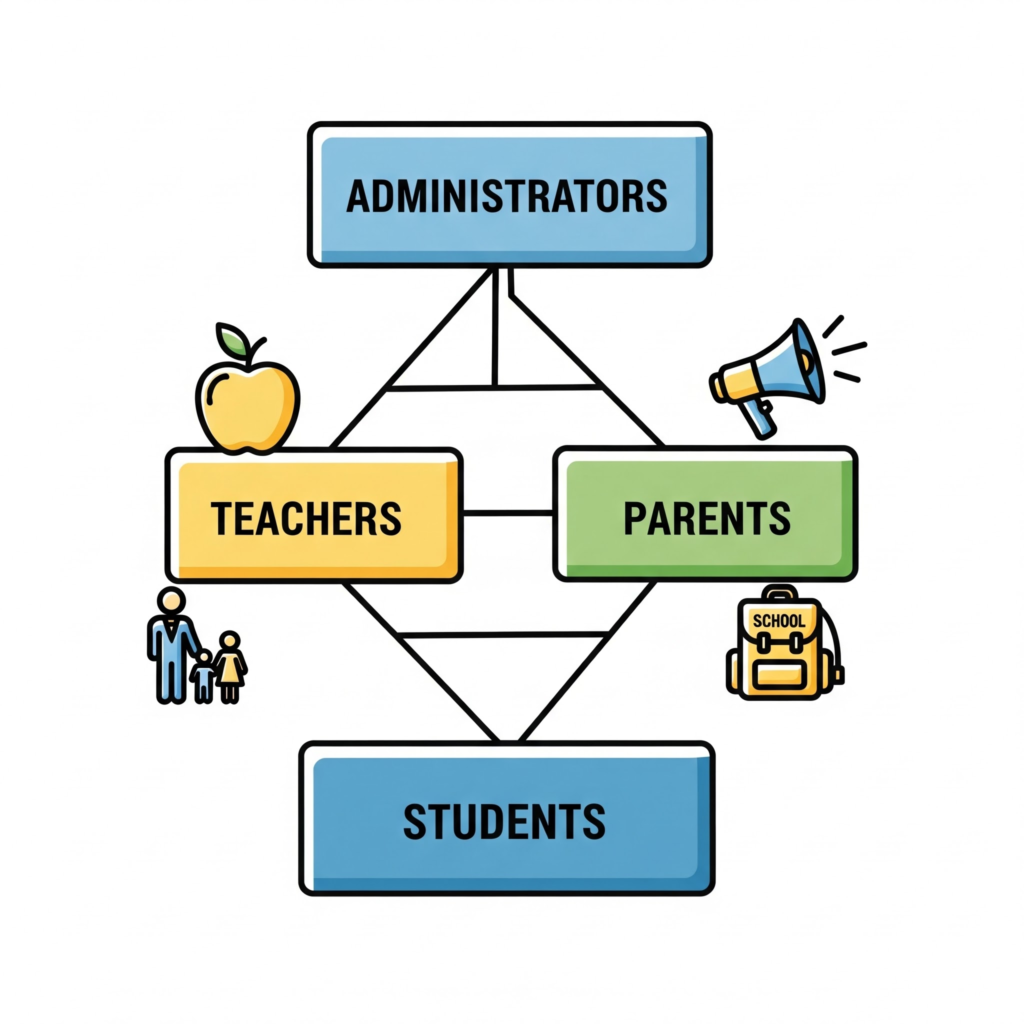
When these four critical groups operate in silos, miscommunications multiply, and accountability breaks down. A unified stakeholder platform remedies this by creating an ecosystem of collaborative transparency.
Empowering the Educator
Through the stakeholder platform, teachers can transition away from being mere dispensers of grades and administrative notices. Armed with real-time data analytics, they can instantly identify which students are falling behind on complex assignments, allowing them to intervene long before a student fails an exam.
Supporting the Home Environment
For parents, the platform replaces the anxious guessing game of “What did you do in school today?” with concrete, actionable insights. Parents receive structured updates regarding upcoming long-form projects, reading lists, and conceptual milestones. This transparency allows families to build a calm environment at home that encourages deep reading and focused study, actively countering the fast-paced distractions of their children’s social lives.
6. From Micro-Interactions to Deep Work: Designing Digital Spaces for Mastery
In his influential framework on modern productivity, author Cal Newport defines “Deep Work” as the ability to concentrate without distraction on a cognitively demanding task. Deep work is the exact mechanism by which a human being masters complex systems, synthesizes disparate ideas, and produces work of genuine value. Conversely, shallow work consists of logistical, low-cognitive tasks performed while distracted.
The foundational design flaw of modern consumer technology is that it trains human minds for perpetual shallow work. To push back against this trend, our educational digital tools must be intentionally built to encourage deep work.
Shallow Work: Continuous Distraction ──> Superficial Knowledge
Deep Work: Sustained Concentration ──> Conceptual Mastery
Eliminating the Micro-Interaction Trap
Many early educational applications mistakenly adopted the engagement metrics of social media, utilizing flashing celebration animations, streak counts, and constant push notifications to keep students clicking. While this design style creates an illusion of engagement, it ultimately fosters the same shallow, dopamine-driven behavioral loops that destroy deep focus.
An enterprise-grade educational platform treats students with cognitive respect. It frames digital tools as functional launching pads for deep, offline intellectual exploration rather than destinations in themselves.
The software layout is designed to guide the student directly to their core task—whether that is drafting an extended essay, reviewing a comprehensive lab report, or studying a geometric proof—and then gracefully steps into the background, leaving the student’s attention entirely free to focus on the work at hand.
7. Implementing the Shift: A Blueprint for School Leaders
Transitioning an entire school community away from fragmented, distracting habits and toward a culture of deep focus is a major institutional challenge. It requires a clear, deliberate deployment strategy that addresses the unique needs of every stakeholder group.
1. Comprehensive Needs Assessment & Consolidation:
Month 1 – Month 2
Conduct a comprehensive audit of all software applications, communication channels, and manual spreadsheets currently utilized across the school. Identify duplicate subscriptions, points of data fragmentation, and administrative roadblocks that contribute to cognitive fatigue among teachers and parents.
2. Deploying the Core Smart School ERP Solution:
Month 3 – Month 4
Migrate central operational databases—including student records, academic scheduling, grading frameworks, and billing structures—into the central ERP platform. Establish strict data governance rules to ensure clean information flow across all administrative departments.
3. Onboarding the Digital Platform For School Stakeholders:
Month 5
Launch dedicated portals tailored to each individual stakeholder group. Provide teachers with templates for curriculum mapping and analytical tracking, while granting parents and students access to clean, non-stimulating dashboards focused entirely on clear academic milestones and long-term learning goals.
4. Cultural Integration & Cognitive Boundary Training:
Month 6 and Beyond.
Establish clear cultural guidelines regarding digital boundaries. Train staff to avoid sending late-night alerts, design assignments that require deep reading and extended written analysis, and actively utilize the ERP analytics to identify and support students struggling with sustained cognitive focus.
8. The Ultimate Dividend: Cultivating Independent, Lifelong Learners
When a school successfully replaces chaotic digital noise with a structured educational ecosystem, the long-term rewards extend far beyond higher test scores and streamlined administration. The ultimate dividend of this institutional shift is the cultivation of independent, deeply reflective human beings who can control their own focus.
In an automated economic landscape, superficial skills and simple rote tasks are increasingly handled by technology. The human capabilities that remain irreplaceable are deep analytical thought, creative problem-solving, and the capacity to synthesize complex systems—the exact skills developed exclusively through slow, focused learning.
“The ability to perform deep work is becoming increasingly rare at exactly the same time it is becoming increasingly valuable in our economy. As a consequence, the few who cultivate this skill, and then make it the core of their working life, will thrive.”
By refusing to let the rapid pace of the infinite scroll dictate the speed of education, and instead utilizing a unified Digital Platform For School Stakeholders alongside a powerful Smart School Erp Solution, schools take a vital stand.
They protect the sanctity of the classroom, preserve the integrity of the developing mind, and teach a generation of students a profound truth: though the screen will always favor the fast, the human mind only achieves true mastery when it embraces the slow.